
Guide for business owners
Stamp Card Reward Tiers: Give Rewards Along the Way
A single reward at the end of a long card asks customers to wait. Several smaller rewards on the same card give them a reason to come back this week, not in two months. Here is how to space them and what to give.
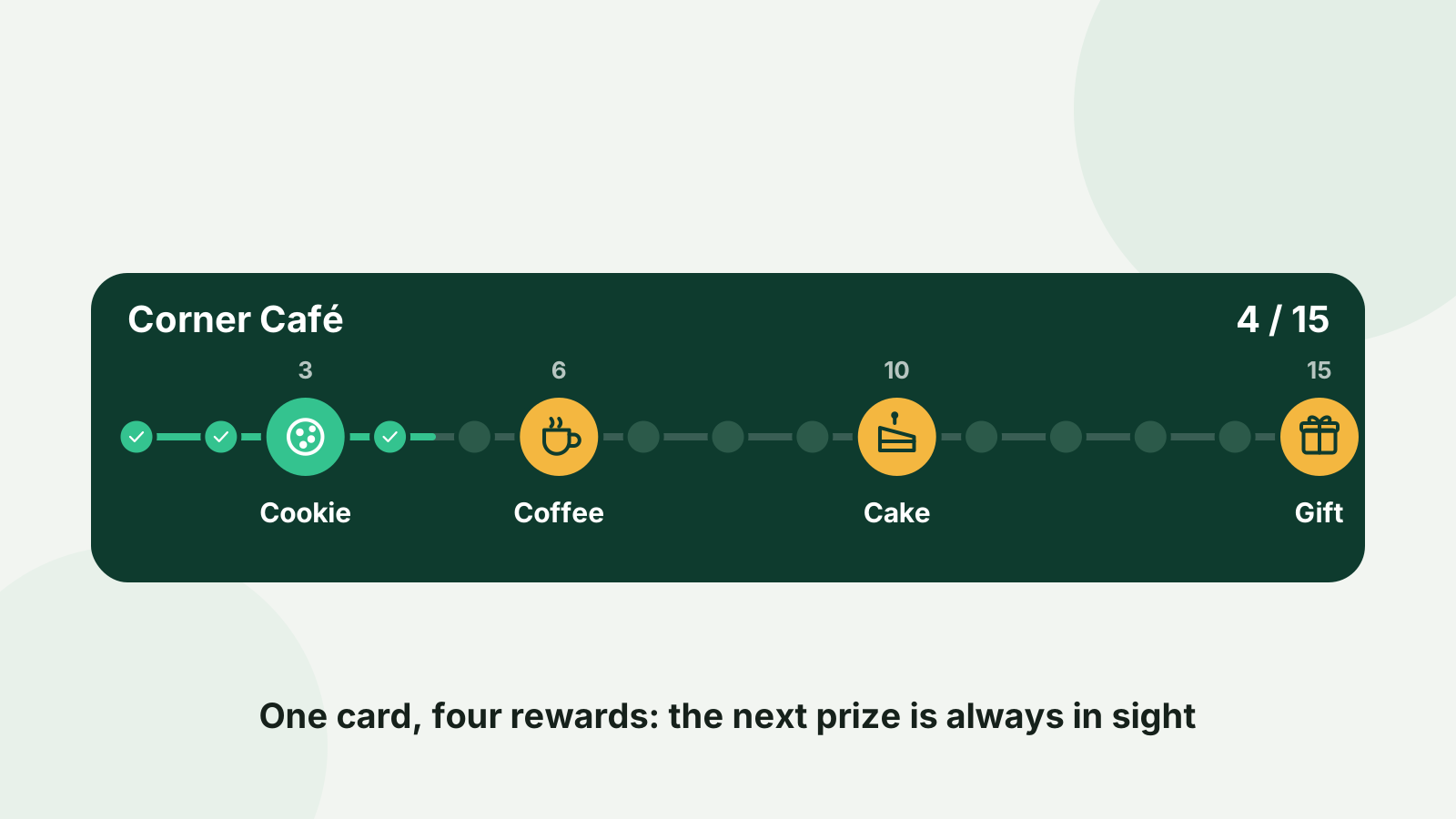
Most stamp cards have one prize, and it sits at the far end. For a customer who visits twice a week that is fine. For anyone who visits twice a month, a ten-stamp card is a five-month commitment with nothing to show for it until the very end, and plenty of people quietly give up around stamp four. Reward tiers fix this by putting several rewards on one card: a small one early, a better one in the middle, the big one at the finish. The card still counts stamps in one line, the customer just meets a prize along the way.
Why one reward at the end loses people
People work harder the closer they feel to a goal. It is sometimes called the goal-gradient effect, and anyone who has watched a coffee card knows it from experience: the last two stamps get filled in a hurry, the first three can take weeks. A single prize at stamp ten stretches that slow early part as far as it will go. The customer has no reason to choose your café on a Tuesday over the one next door, because nothing is going to happen on this particular visit.
A reward at stamp three changes what a visit means. Now the next scan gets them something, and the card they just opened already feels like it is going somewhere. The reward that matters most is often the smallest one, because it is the one that turns a first-time visitor into a second-time visitor. If you have read how many stamps a card should have, tiers are the next step: instead of shrinking the card until it feels reachable, you keep a meaningful long round and break the road into stretches that each pay out.
What a reward ladder looks like
One counter, several thresholds. The customer collects stamps as usual. When the count crosses a threshold, they earn that reward. At the last threshold the card closes the round and starts again from zero. A typical ladder for a café:
| Stamp | Reward | Cost to you (example) |
|---|---|---|
| 3 | Free cookie | €0.40 |
| 6 | Free coffee | €1.00 |
| 10 | Dessert of the day | €1.50 |
| 15 | Any drink and a pastry | €1.90 |
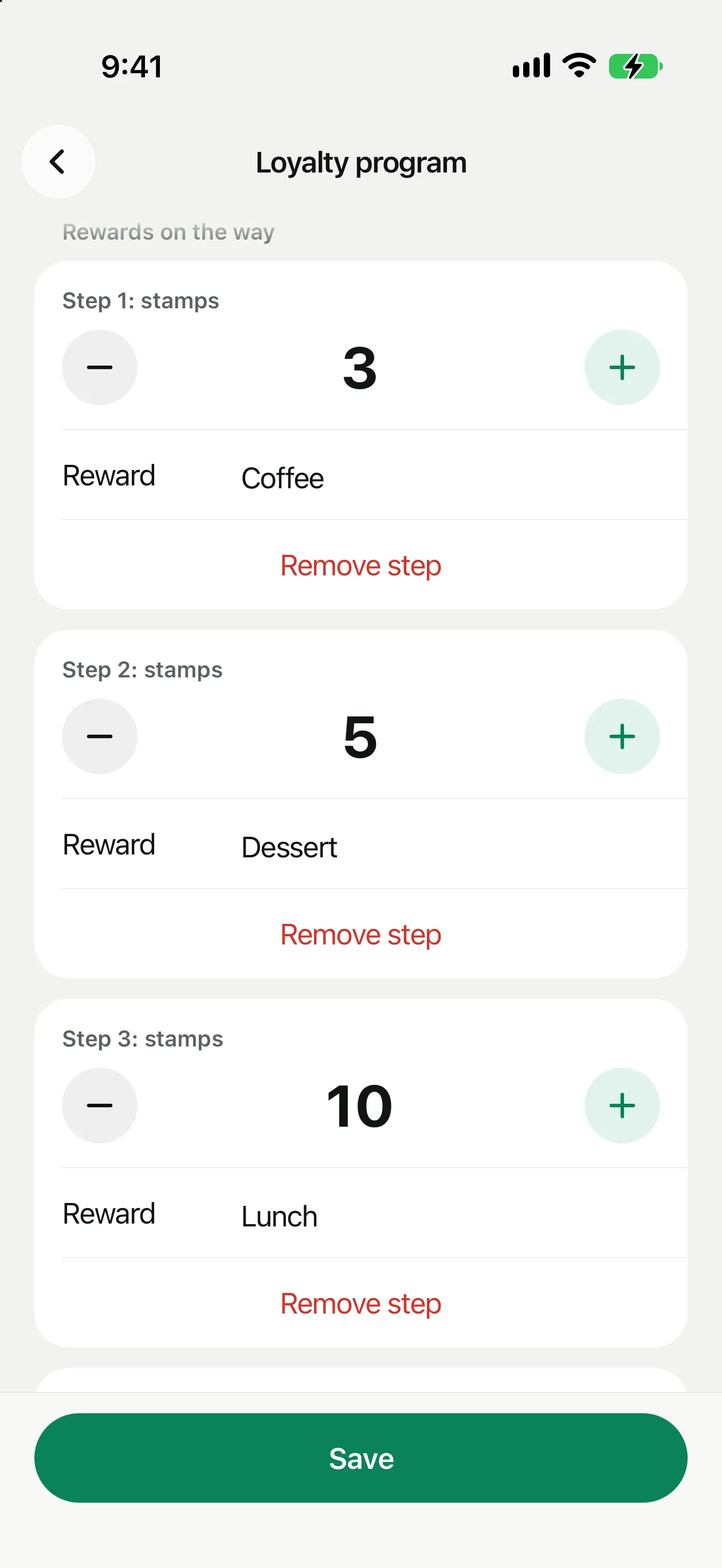
Rounds can look different: 3 → coffee, 5 → dessert, 10 → lunch, 15 → gift is just as valid. What matters is that the gaps are not all the same and that the rewards grow.
How to choose thresholds
Start from the finish line, not the first step. Pick the round length the way you would for a single-reward card, using your customers' real visit rhythm: a long round for people who come several times a week, a shorter one for monthly visitors. Then place the early rewards.
- First reward at 15 to 25 percent of the round. Stamp 3 of 15, stamp 2 of 10. It should arrive within the first week or two, before the habit has had time to fade.
- Middle rewards spread out, with the gaps getting longer. 3, 6, 10, 15 gaps of three, three, four, five. Early gaps are short because motivation is lowest there.
- Keep it to three or four rewards. With six, the card turns into a menu, and the staff end up explaining it. Fewer, clearer steps are easier to remember and to say out loud at the counter.
- The last step closes the round. That is the biggest reward, and the counter starts over after it.
How to choose the rewards
Think of the ladder as one budget, not as separate gifts. Take your average ticket, multiply by the number of stamps in the round and decide what share of that revenue you are willing to give back. With a €4 ticket and 15 stamps, the round brings in about €60. If you are comfortable giving back around 8 percent, that is €4.80 for the whole ladder, which is exactly what the example above costs: 0.40 + 1.00 + 1.50 + 1.90. The percentage is your decision, not a rule; the point is to fix the total first and divide it second.
Then make each reward feel like a real thing rather than a token:
- Prefer rewards that cost you little and look generous: a drink upgrade, a side, a free topping, something from the display case.
- Make the early reward a taste, not a discount. A free cookie brings people back for the cookie and sells the coffee next to it.
- Use the final reward for something you would be proud to hand over: a free lunch, a bag of beans, a branded mug. It is the one people photograph.
- Avoid cash-like rewards in the middle. A "10% off" at stamp five invites people to hold it until a big order.
Mistakes that make a ladder worse than a single reward
- Rewards too close together. Stamp 4, 5 and 6 each paying out means the card gives everything away in a week and the final prize stops mattering.
- A tiny first reward on a huge round. A cookie at stamp 3 of a 40-stamp card sets the wrong expectation: the next prize is a long way off and the customer can feel it.
- Different rewards at every counter. If the cashier cannot say from memory what stamp 6 gives, the customer will not remember it either. Write the ladder on the sign next to the QR code.
- Skipping the sums. Four attractive prizes can quietly add up to a quarter of the revenue of the round. Add up the cost before you launch.
How it works in Pikarta 2.0
In Pikarta 2.0 a stamp card can have several reward steps on a single counter. Open Settings → Program and under "Rewards on the way" tap "Add a reward step". For each step enter the stamp number and the reward, for example 3 → free cookie. The main reward and the round length stay where they were; the last step is the end of the round. You can also add steps while setting up your first card, on the program step of onboarding, via "+ Add a step". A card without steps behaves exactly as before.
What changes for the customer and the cashier:
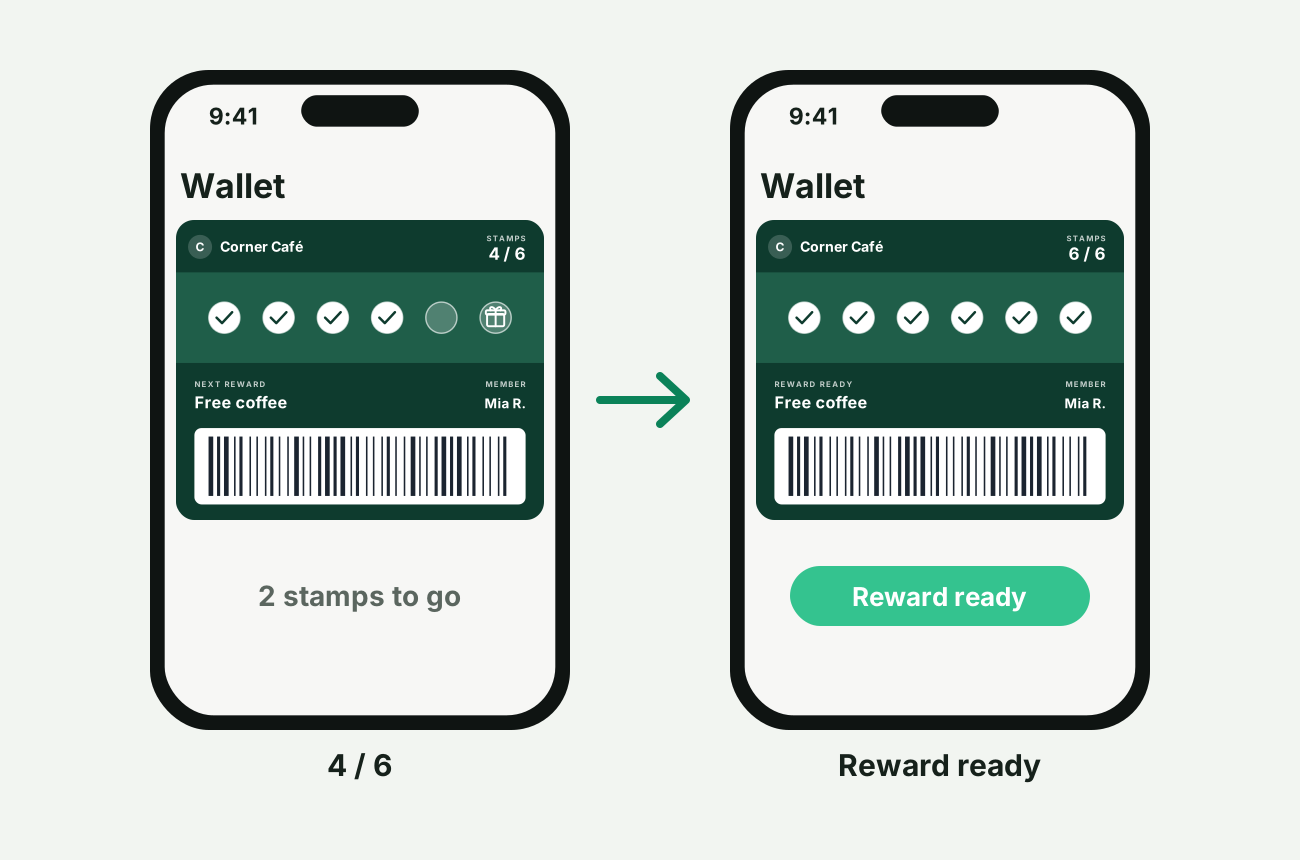
- The card in Apple Wallet and Google Wallet shows progress toward the next reward, for example "4 / 5", and the name of that reward. When a reward is ready it says so. The back of the card lists all the steps.
- If the card has a stamp banner (it holds up to 12 stamps), the slots where rewards are earned get a reward icon, so the customer sees the prizes along the row. A longer round shows progress as a number instead.
- The sign-up page lists the steps too, so a new customer knows what is waiting before they join.
- On the cashier's screen, scanning a customer who has just crossed a step shows the reward to hand over. If a guest reached stamp 5 without collecting the stamp-3 reward, the rewards wait: the cashier sees "ready to redeem: 2" and the oldest one is given first.
Two things to know before you switch it on. Cashiers need the 2.0 version of the app, because older versions only understand the final reward. And if you change the steps while customers are already mid-card, nobody gets a gift retroactively: steps at or below a customer's current stamp count are treated as already given. More on the details is in the stamp card help article.
A simple way to start
If you already run a stamp card, do not rebuild it. Keep the round length and the main reward, then add one early reward at roughly a fifth of the way in and one in the middle. Run it for a month and look at two things: how many customers reach the first reward, and how many come back within a week of getting it. If the first number is high and the second is not, the early reward is too generous or too forgettable. For help picking between stamps and other mechanics at all, see stamps, points, cashback or discount, and for the basics of the format, digital stamp cards.
Add reward steps to your stamp card. 30-day free trial, no card details needed to start.
Get Pikarta on the App StoreQuestions
What owners ask about reward tiers
How many rewards should a stamp card have?
Three or four is a good range: one early, one or two in the middle and the main one at the end. Beyond that the card gets hard to remember and to explain at the counter, and the total cost is harder to control.
Does a ladder cost more than a single reward?
Usually yes, because you give something away more often. That is why the useful way to plan it is to fix the share of round revenue you are willing to give back, then divide it across the steps. A cheap early reward that costs pennies often does more for repeat visits than a larger single prize at the end.
What happens when a customer passes a step before collecting the reward?
In Pikarta 2.0 the rewards wait. If a guest skipped the stamp-3 reward and now has five stamps, the cashier sees that two rewards are ready, and the oldest one is handed over first.
Can I add steps to a card that customers already use?
Yes. Add them in Settings → Program. Customers keep their stamps, and steps that are at or below their current count are treated as already given, so nobody receives rewards retroactively. Cashiers should update to version 2.0 first.
30 days free
Put more than one reward on your stamp card
15 minutes, no code, free for 30 days.